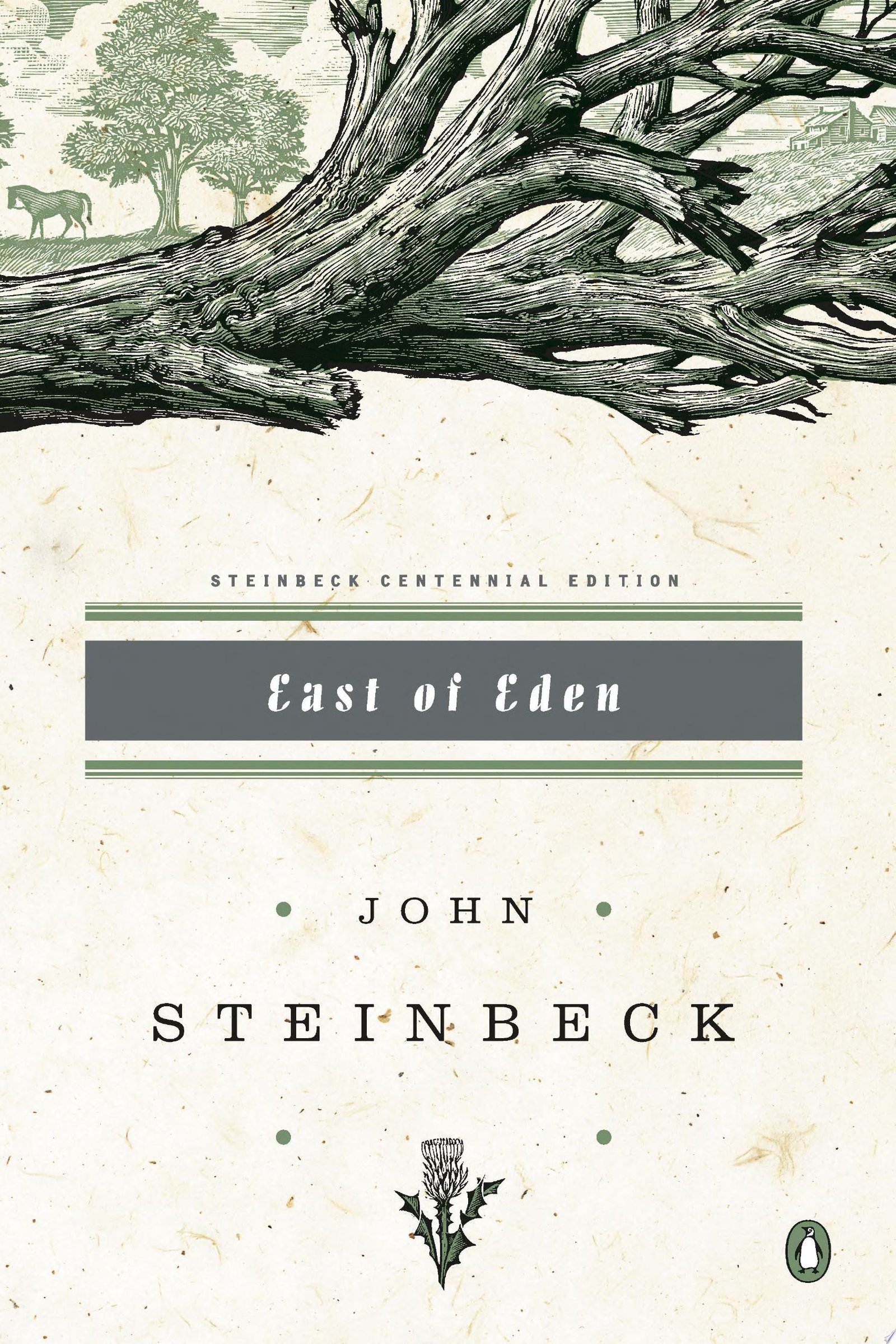

Cover of East of Eden by John Steinbeck

5 book recommendations

Books Like “East of Eden” by John Steinbeck

John Steinbeck's East of Eden captivates readers with its sweeping multi-generational family saga, profound exploration of good and evil, and unforgettable portraits of flawed humanity. If you crave sprawling narratives rich with moral complexity, deep emotional resonance, and grand scale, explore our curated collection to discover your next favorite read.

  1. Cover of The Brothers Karamazov by Fyodor Dostoevsky

    Cover not available

    The Brothers Karamazov

    by Fyodor Dostoevsky

    Considered by some to be the greatest novel ever written, The Brothers Karamazov stands as a masterpiece of Russian literature. In the trials of three brothers—Dmitri, Ivan, and Alyosha—Dostoevsky traces threads of the deepest questions, from belief and doubt, to joy and suffering, to hope and despair. Dostoevsky himself was a man of profound faith who did not shy away from the darkest aspects of human life. His narrative, both intensely scriptural and inextricably Russian, combines ardent emotion, vigorous dialogue, and penetrating psychological insight to search the mysterious depths of the heart.

    Why it's similar

    Like East of Eden, this novel explores intense sibling rivalry, complicated father-son dynamics, and the struggle between good, evil, and human free will through a deeply philosophical lens. Both works frame these familial tensions using explicit biblical motifs and moral inquiries.

    What's different

    Set in 19th-century Russia, the narrative leans heavily into psychological dialectic and manic courtroom drama rather than the pastoral, sprawling American realism of Steinbeck's Salinas Valley.

  2. Cover of Angle of Repose by Wallace Stegner

    Cover not available

    Angle of Repose

    by Wallace Stegner

    An American masterpiece and iconic novel of the West by National Book Award and Pulitzer Prize winner Wallace Stegner—a deeply moving narrative of one family and the traditions of our national past.

    Lyman Ward is a retired professor of history, recently confined to a wheelchair by a crippling bone disease and dependant on others for his every need. Amid the chaos of 1970s counterculture he retreats to his ancestral home of Grass Valley, California, to write the biography of his grandmother: an elegant and headstrong artist and pioneer who, together with her engineer husband, made her own journey through the hardscrabble West nearly a hundred years before. In discovering her story he excavates his own, probing the shadows of his experience and the America that has come of age around him.

    Why it's similar

    Both novels function as grand, multi-generational chronicles of the American West, closely tying the rugged landscape to the ambition, moral failings, and personal tragedies of pioneering families.

    What's different

    Stegner's novel employs a cynical modern narrator reconstructing his grandparents' history through letters, creating a quiet, reflective reading experience compared to Steinbeck's sweeping, mythic third-person storytelling.

  3. Cover of Gilead by Marilynne Robinson

    Cover not available

    Gilead

    by Marilynne Robinson

    Rev. John Ames is 77 years old in 1956, in failing health, with a much younger wife and six-year-old son; as a preacher in the small Iowa town where he spent his entire life, he has produced volumes and volumes of sermons and prayers, "[t]rying to say what was true." But it is in this mesmerizing account?in the form of a letter to his young son, who he imagines reading it when he is grown?that his meditations on creation and existence are fully illumined. Ames details the often harsh conditions of perishing Midwestern prairie towns, the Spanish influenza and two world wars. He relates the death of his first wife and child, and his long years alone attempting to live up to the legacy of his fiery grandfather, a man who saw visions of Christ and became a controversial figure in the Kansas abolitionist movement, and his own father's embittered pacifism. During the course of Ames's writing, he is confronted with one of his most difficult and long-simmering crises of personal resentment when John Ames Boughton (his namesake and son of his best friend) returns to his hometown, trailing with him the actions of a callous past and precarious future. In attempting to find a way to comprehend and forgive, Ames finds that he must face a final comprehension of self?as well as the worth of his life's reflections.

    Why it's similar

    Both works center on profound theological questions of grace, jealousy, and the legacy fathers pass down to their sons, incorporating explicit Cain and Abel archetypes.

    What's different

    Gilead is an intimate, meditative epistolary novel told from a single first-person perspective, lacking the sprawling cast, melodramatic violence, and epic multi-decade scope of East of Eden.

  4. Cover of Absalom, Absalom! by William Faulkner

    Cover not available

    Absalom, Absalom!

    by William Faulkner

    NOBEL PRIZE WINNER • Family drama and the legacy of slavery haunt this epic tale of an enigmatic stranger in Jefferson, Mississippi—from one of the most acclaimed writers of the twentieth century.

    One of The Atlantic’s Great American Novels of the Past 100 Years

    “Read, read, read. Read everything—trash, classics, good and bad, and see how they do it. Just like a carpenter who works as an apprentice and studies the master. Read! You’ll absorb it. Then write. If it is good, you’ll find out. If it’s not, throw it out the window.” —William Faulkner

    Absalom, Absalom! is Faulkner’s epic tale of Thomas Sutpen, a man who comes to the South in the early 1830s to wrest his mansion out of the muddy bottoms of the north Mississippi wilderness. He was a man, Faulkner said, “who wanted sons and the sons destroyed him.”

    Why it's similar

    Both stories portray a family empire destroyed by patriarchal pride, fraternal conflict, and biblical parallels of ancestral guilt spanning generations.

    What's different

    Faulkner relies on dense, fragmented stream-of-consciousness narration and competing witness accounts set in the American South, resulting in a far more challenging, non-linear reading experience than Steinbeck's straightforward prose.

  5. Cover of Song of Solomon by Toni Morrison

    Cover not available

    Song of Solomon

    by Toni Morrison

    In this celebrated novel, Nobel Prize-winning author Toni Morrison created a new way of rendering the contradictory nuances of black life in America. Its earthy poetic language and striking use of folklore and myth established Morrison as a major voice in contemporary fiction. "Song of Solomon" begins with one of the most arresting scenes in our century's literature: a dreamlike tableau depicting a man poised on a roof, about to fly into the air, while cloth rose petals swirl above the snow-covered ground and, in the astonished crowd below, one woman sings as another enters premature labor. The child born of that labor, Macon (Milkman) Dead, will eventually come to discover, through his complicated progress to maturity, the meaning of the drama that marked his birth. Toni Morrison's novel is at once a romance of self-discovery, a retelling of the black experience in America that uncovers the inalienable poetry of that experience, and a family saga luminous in its depth, imaginative generosity, and universality. It is also a tribute to the ways in which, in the hands of a master, the ancient art of storytelling can be used to make the mysterious and invisible aspects of human life apparent, real, and firm to the touch.

    Why it's similar

    Both books weave rich generational legacies, biblical naming conventions, and archetypal struggles between rival kin to interrogate how individuals choose between self-destruction and personal redemption.

    What's different

    Morrison integrates African American folklore and magical realism to examine the specific racial and cultural history of Black Americans, whereas East of Eden adheres to Western American naturalism and European-descended settler history.

Looking for something else?

Use our book recommendation tool to discover books similar to any of your favorites.

Find similar books with LibroMatch